Bishop Justin J. McCarthy
Total Catholic Education
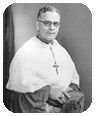
Bishop Justin J. McCarthy, Auxiliary Bishop of Newark, 56 years old, was installed as the second bishop of Camden at the Cathedral of the Immaculate Conception on March 19, 1957. The history of Bishop McCarthy in Camden is often glossed over quickly because of the brevity of his tenure. Camden’s second bishop died after a fatal heart attack on December 26, 1959. Yet, the shortness of time did not curtail the great impact this prelate made on the diocese.
His chief historical legacy was his commitment to total Catholic education. The new schools that were opened and the additions made to the existing ones made room for an increase of over 5,000 students at the elementary level and 1,000 students at the high school level.
A major effort was also undertaken to upgrade the teaching of religion to youth in public schools. The renewal began with intensive training for religious education teachers. At the time of Bishop McCarthy’s death, some 20,000 youth were enrolled in the Confraternity of Christian Doctrine classes, an increase of almost 100 percent from the time of his installation.
Hispanic Ministry
The Bishop’s second major priority was ministry to the rapidly growing Hispanic population in the Diocese. There were at the time some 20,000 Hispanics, mostly from Puerto Rico, many of whom had come to work on the farms and then remained as permanent residents.
As early as June 1957, the Bishop displayed serious concern for the large number of Spanish-speaking immigrants in the diocese, the difficulties experienced by the migrant farm workers, and their need to be served by the Church in their native language.
A Mobile Chapel for migrants, named Capilla Rodante Santa Ana, was dedicated in 1957 by Bishop McCarthy. Following a request from the Bishop, four sisters of the Oblates of the Sacred Heart arrived in Camden in December 1959 from El Salvador to teach religion and to do social work among parishioners of Our Lady of Fatima Church in Camden. They helped train girls to teach catechism in the homes of the Hispanic Our Lady of Fatima Parish.
Another priority of Camden’s second bishop was encouragement of the laity to participate actively in civic affairs. In addition, various lay groups were of special concern to Bishop McCarthy, including the Friends of the Sacred Heart, the Camden County Bar Association, the Medical Guild, the St. Joseph’s Guild, the Knights of Columbus, the Catholic Daughters of America, Our Lady of Lourdes Auxiliary, and the Bishop’s Committee for Charity.
BLAZON
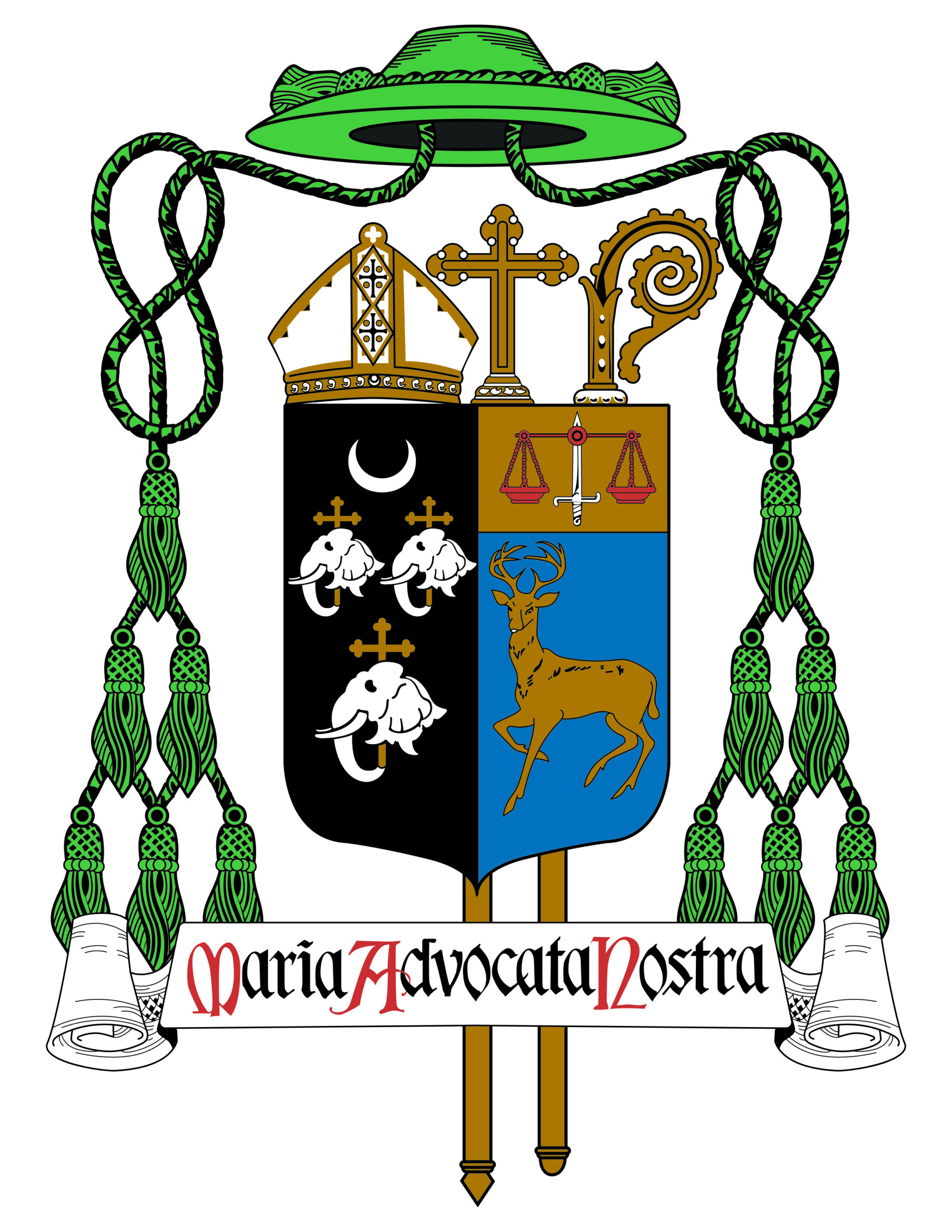
Impaled Arms. Dexter: Sable, three latin crosses botonny or, debruised at their base with three elephant’s heads erased argent, in chief a crescent of the last (Diocese of Camden). Sinister: Vert, a stag trippant or, attired and unguled gules, on a chief of the second a sword, hilt to the base, bearing the Scales of Justice of the third (Bishop McCarthy). Motto: “Maria Advocata Nostra.”
SIGNIFICANCE
The entire “achievement,” or coat of arms as it is generally called, is composed of the shield with its charges, the motto and the external ornaments. As one looks at the shield, the term dexter and sinister must be understood contrariwise, as the shield was worn on the arm in medieval days and these terms were used in the relationship of one behind the armor.
The dexter impalement, on the left to the viewer, bears the arms of the Diocese of Camden. The black field and the three silver elephant’s heads are derived from the coat of arms of Charles Pratt, first Earl of Camden and Lord Chancellor of England, whose illustrious name the See city bears. In 1773 Jacob Cooper, a descendant of William Cooper who in 1681 had built a home just below the mouth of the Cooper river, laid out a town and named it in commemoration of Lord Cam- den, the friend and defender of the rights of the American Colonies. Indeed, the
sense of justice prevailed so strongly in the Chancellor that the English government asked him to resign his high post, after one of his judicial decisions denounced the Stamp Act as a breach of the English Constitution, and declared taxation without representation to be sheer robbery.
Three golden crosses accompany the elephant’s heads in honor of the Blessed Trinity, and afforded a “difference” to make the shield peculiar to the Diocese of Camden.
The crescent, the emblem of the Mother of God under the title of the Immaculate Conception, denotes the titular of the Cathedral Church.
The sinister impalement on the right of the shield bears the personal arms of Bishop McCarthy.
This coat of arms bears the ancient and well-known symbol of the McCarthy family, the stag trippant, albeit “differenced” in tinctures as is a custom in prelatical heraldry. The McCarthy arms usually consists of a red stag on a silver field. This illustrious family, which built Blarney Castle in the year 1449 and also erected Ross Castle and Mucross Abbey, has many branches. It is unusual to have such a family of so many branches bear the same coat of arms for all branches with only minor, if any, differences in tinctures. Woulfe, in his “Irish Names and Surnames,” tells us that the name McCarthy is derived from the old Celtic “Caratacos” meaning loving. It was an ancient Irish personal name. The McCarthys were the chief family of Eoghanacht, i.e., the descendants of Eoghan Mor, son of Oilioll Olum, King of Munster in the third century. Prior to the Anglo-Norman invasion, the McCarthys were Kings of Desmond or South Munster; but shortly after that event they were driven from the plains of Tipperary into the present counties of Cork and Kerry. The McCarthys were divided into three great branches, the heads of which were known respectively as McCarthy More, who resided chiefly in Kerry, McCarthy Reagh, Lord of Carbery in West Cork, and McCarthy of Muskerry-and there were numerous minor branches.
The baptismal name of the Bishop, Justin, is represented in the chief or up- per compartment of the coat of arms. Justin, a common name among the Mc- Carthys, is derived from a Gaelic root which means “noble judge.” Hence, the representation of the Scales of Justice in the chief. The sword with its red tincture, as well as the like tincture of the scales, represents St. Justin, Philosopher and Martyr, the baptismal patron of Bish- op McCarthy. St. Justin, whose feast is celebrated on April 14th, was born in the second century at Nablus in Palestine of pagan parents. He was converted to Christianity when about thirty years of age by reading the Scriptures and wit- nessing the heroism of the martyrs. He wrote some of the most instructive sec- ond century writings which we possess. He was martyred in Rome under the or- ders of Junius Rusticus, Prefect of Rome, in the reign of Marcus Aurelius. Red, the liturgical color of martyrdom is appropriate for this saint who was beheaded in Rome in testimony of his Faith. The acts of his trial and martyrdom are among the most valuable and authentic which I have come down to us.
The word is also a symbol of “Our Lady of Sorrows,” the titular of the church of which Bishop McCarthy was pastor at the time of his appointment to the hierarchy. The sword recalls the words of the Prophet Simeon when the Mother of God presented her Divine Son in the temple: “Behold, this child is destined for the fall and for the rise of many in Israel, and for a sign that shall be con tradicted. And thy own soul a sword shall pierce, that the thoughts of many hearts may be revealed (Luke II. 34, 35).” The motto, “Maria Advocata Nostra,” is translated “Mary Our Advocate.” The external ornaments are composed of the green pontifical hat with its six tassels on each side disposed in three rows, and the precious mitre, the processional cross and the crosier, all in gold. These are the presently accepted heraldic trappings of a prelate of the rank of Bishop. Before 1870, the pontifical hat was worn at solemn cavalcades held in conjunction with papal functions. The color of the pontifical hat and the number and color of the tassels were signs of the rank of a prelate, a custom which is still preserved in ecclesiastical heraldry.