
Bishop Joseph
Andrew Williams
The Most Reverend Joseph Andrew Williams is the ninth bishop of Camden, New Jersey. He was appointed coadjutor bishop of the Diocese of Camden on May 21, 2024 by Pope Francis, and assumed the role of ordinary of the diocese on March 17, 2025.
Bishop Williams was ordained a priest of the Archdiocese of Saint Paul and Minneapolis in 2002. His episcopal ordination took place January 25, 2022, the Feast of the Conversion of Saint Paul. As auxiliary bishop, he served as moderator and priest-in-solidum of the Church of Our Lady of Guadalupe in Saint Paul. Prior to that, he served as pastor of Saint Stephen in Minneapolis (2008-2022); parochial administrator of Holy Rosary in Minneapolis (2020-2022); ministered as a parochial vicar at the Cathedral of Saint Paul in Saint Paul (2002-2004) and at Divine Mercy in Faribault (2004-2005). He was pastor of Saint Mathias in Hampton and Saint Mary in New Trier (2005-2008). He has also served as coordinator of the Archdiocesan Outreach to Persons with Disabilities (2003-2005).
He was appointed the Archdiocesan Vicar for Latino Ministry in 2018. He is a member of the board of trustees for The Saint Paul Seminary and Saint John Vianney College Seminary. He has served as chaplain of the Minnesota House of Representatives.
Born May 2, 1974, to Dr. Gary and Mary MacDonald Williams, Bishop Williams is the third of nine children. He grew up in Stillwater, where he attended Saint Croix Catholic School and Stillwater High School. His brother, Father Peter Williams, ordained in 2004, is a priest of the Archdiocese, and is Pastor of Saint Ambrose in Woodbury, Minnesota.
Bishop Williams holds a B.A. in biology from the University of Minnesota, Morris, graduating summa cum laude in 1996. He studied philosophy and pre-theology at Franciscan University of Steubenville, Ohio, from 1996-1998 and attended The St. Paul Seminary School of Divinity in St. Paul from 1998-2002, where he earned a Master of Divinity degree. He was ordained a priest at age 28.
Bishop Williams is known for his longtime ministry to Latino and Spanish-speaking Catholics in the Archdiocese of Saint Paul and Minneapolis, beginning in Faribault, where he and other parish leaders worked to bring healing to a Latino community that had been wounded by drug raids. Members of both of his most recent parishes are predominantly Latino, and he has worked to change negative cultural perceptions of undocumented immigrants. He has led neighborhood-based evangelization efforts, which include knocking on doors and inviting people to Mass and faith formation.
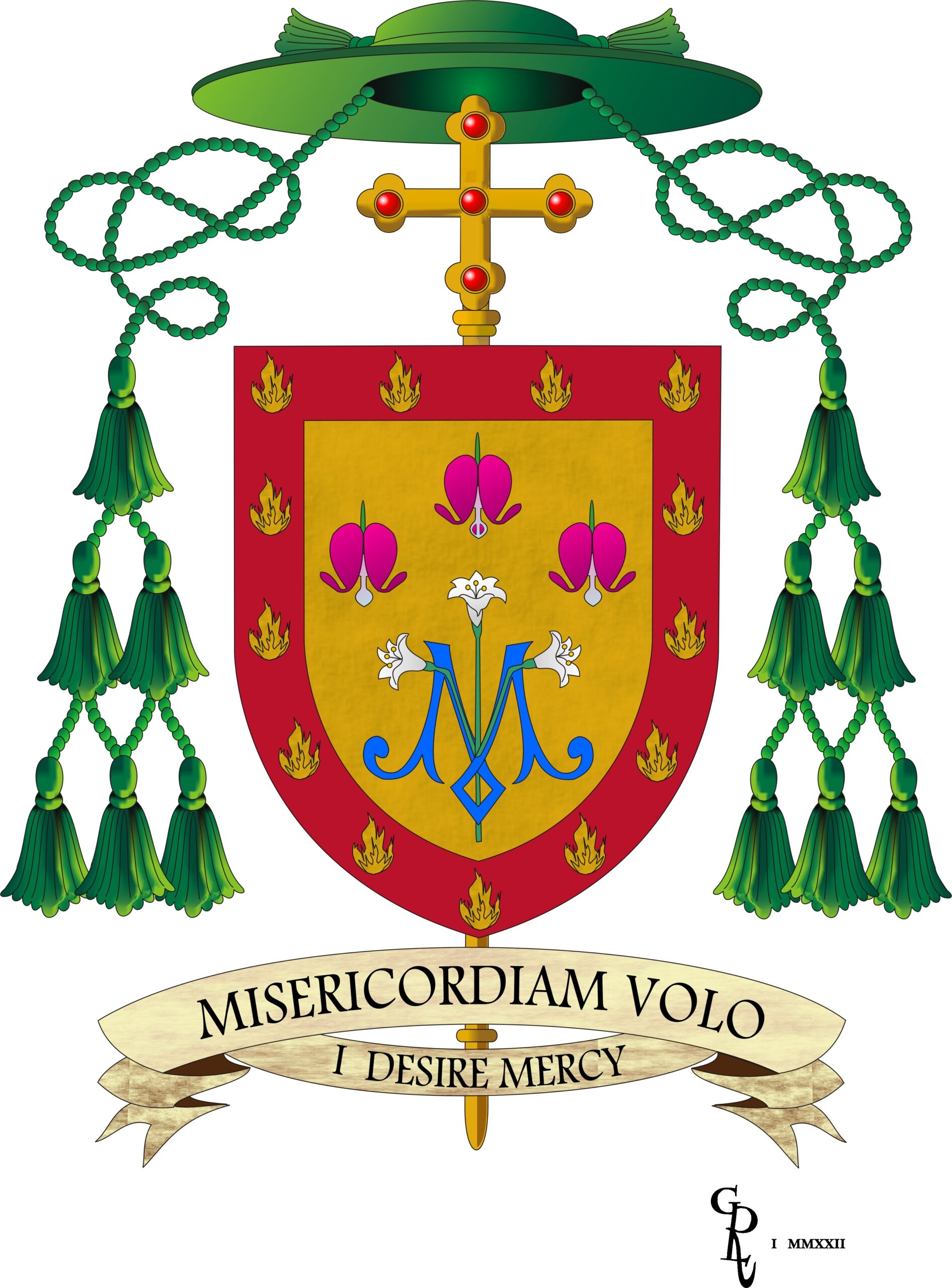
The following is an explanation of Bishop Joseph Williams’ episcopal motto and coat of arms. Each bishop has a coat of arms that displays his episcopal motto. According to “The Church Visible” by James-Charles Noonan Jr., the green hat is a “galero,” a pilgrim’s hat. Connected to the hat via cords are 12 green tassels, or “fiocchi,” that signify Bishop Williams’ rank as bishop. All bishops’ coat of arms include a jeweled processional cross behind the shield.
Motto: ‘Misericordiam volo’
“I desire mercy” (Mt 9:13). Jesus commands the “righteous” to learn what he desires most – and what each of us needs most – mercy. From the “Call of Matthew,” where Jesus reveals himself to be a physician who came to call the sick, that is, the sinner. Bishop Williams dreamed of being a doctor when he was a boy. He found his dream fulfilled, not in a medical practice, but in these words of our Lord.
‘Ex Corde Scisso Ecclesia Nascitur’
“From the broken Heart the Church is born.” This theological truth, found in an inscription at the base of the Altar of the Sacred Heart in the Cathedral of St. Paul, is the key to unlocking the entire symbolism of the coat. It reminds us that the mercy Jesus desired was not cheap. It broke his Heart to give life to ours.
The Bleeding-Heart Flower
A perennial plant that Bishop Williams’ father planted in front of his childhood home in Stillwater. Meditating closely on the heart-shaped flower is bound to bring the believer in spirit to Calvary. The exterior petals are opened from the bottom and falling from the “broken” heart is a basal sac that contains a drop of dew and inner petals that look from a distance like two drops of blood: “But when they came to Jesus and saw that he was already dead, they did not break his legs, but one soldier thrust his lance into his side, and immediately blood and water flowed out” (Jn 19:33-34). The Hearts of the Father (left) and the Spirit (right) were also opened during the Passion, but only the human Heart of the Incarnate Son could provide the blood and water that would give life to the Church. A parishioner of St. Stephen, Pedro, has kept a bleeding-heart plant blooming in the rectory garden since hearing of its significance to “Padre José.”
The Blue ‘M’
At the foot of the Cross is Mary who, with John the Beloved, forms the nucleus of the new believing community (Jn 19:25) which becomes “ecclesia” (Church) through the water (Baptism) and blood (Eucharist) downpoured. Bishop Williams counts Mary’s love, which his mother and grandmother blessed him with, to be the greatest mercy of his life.
Blossoming Staff
Bishop Williams is fond of a story about his patron saint originating in the Protoevangelium of James, in which St. Joseph’s worthiness to be the husband of Mary is proven when a dove came out of his staff: “Joseph! Joseph! You have been chosen by lot to take the virgin into your own keeping.” In the Middle Ages, the legend developed to have a flower blossoming from the rod, which we see in Rafael’s “The Marriage of the Virgin Mary” and also in the image of St. Joseph in our Cathedral.
Gold Background
As the most precious of metals, gold symbolizes the surpassing preciousness of faith (1 Pt 1:7), which will provide strength to support Bishop Williams’ pastoral ministry.
The Thirteen Tongues of Flame
These are the “tongues as of fire” that fell upon Mary and the Twelve Apostles (and the other disciples) in the Upper Room on the day of Pentecost (Acts 2:3). Here too we see an expression of the truth, “ex corde scisso Ecclesia nascitur.” For the evangelist Luke, the Spirit-baptism of the Church on Pentecost can only occur after the passion-baptism of Jesus on Calvary: “I have come to set the earth on fire, and how I wish it were already blazing! There is a baptism with which I must be baptized, and how great is my anguish until it is accomplished!” (Lk 12:49-50). Once again, we understand that the fire of mercy given to the followers of Jesus is costly. As at Calvary, so too in the Upper Room, the mother of Jesus is at the center of the scene. Mary “filled with the Holy Spirit” is the last image we have of her in the New Testament. It was the “power” of the Spirit that made her and the Apostles merciful witnesses of Jesus’ resurrection to the “ends of the earth” (Acts 1:8). Bishop Williams is praying for that same power to be a true successor to the Apostles. As he celebrates the Sacrament of Confirmation, he will pray too that the grace of Pentecost be extended in time and space so that all the faithful would experience “a special strength of the Holy Spirit to spread and defend the faith by word and action as true witnesses of Christ, to confess the name of Christ boldly, and never to be ashamed of the Cross” (Catechism of the Catholic Church, Nos. 1302-1303).
Published online by The Catholic Spirit, Archdiocese of Saint Paul and Minneapolis, Jan. 21, 2022.