Archbishop Celestine Damiano
New Bishop February 1960
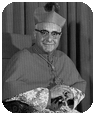
It was announced on February 10, 1960 that the third bishop of Camden would be Archbishop Celestine Damiano, 48, then Apostolic Delegate to South Africa. The Archbishop was a priest of the Buffalo Diocese, where he had been a pastor, and afterwards, from 1947 to 1952, a member of the staff in Rome of the Congregation for the Propagation of the Faith.
From 1952 to 1960, Archbishop Damiano had in many ways, almost singularly, changed the face of the Church in South Africa. His great respect for the dignity of the human person, of whatever race or ethnic origin, would not permit him to silently fulfill the duties of a papal delegate in a country dominated by apartheid. As he worked in a pastoral manner with other bishops and with the priests of South Africa, he insisted quite vocally on new modes of Church advocacy for the equality of the races.
Shortly after his installation in Camden, where he described himself as above all a “citizen of the Church,” the Archbishop spoke publicly of the plight of the 25,000 Puerto Ricans in the diocese. “Give them an opportunity to belong, to be educated, to progress.”
For the next seven years of his time in Camden, the Archbishop urged and put into action several initiatives to provide a better life for Hispanics. Particular significant contributions made under his direction were the opening of a pre-natal clinic for expectant mothers in North Camden, staffed by the Hospitaler Sisters he brought from Rome in 1966, and the establishment in 1962 of the Spanish Catholic Center which is now a parish for all Hispanics in the city of Vineland. The works of the Neighborhood Apostolate were also important achievements in the upgrading of pastoral care for Hispanics.
Brazil Missions
A ministry began in 1961 with Father (later Monsignor) Edward Kennedy and Father (later Monsignor) Felix O’Neill assigned to what would be known as Camden’s Brazil Missions. To this day it is one of Archbishop Damiano’s initiatives which broadened priests and people to understand the universality of the Church and to commit themselves to generosity beyond the borders of the local church.
Probably the most lasting memorial of the Archbishop’s ministry in Camden was his establishment of the House of Charity Appeal for funding the human services of the diocese. It is noteworthy that the idea of the House of Charity first came from remarks made by Pope John XXIII in 1962. The Holy Father saw all religions working together to help each other. The concept for the House of Charity was born with John’s words, “I am your brother Joseph, come into your Father’s house.”
In rapid succession, several new social ministries to the poor and needy were announced: the pre-natal clinic on State Street in North Camden, additional classes for the developmentally disabled and handicapped persons, the construction of a new complex planned for the educable and trainable in Deptford Township, and the opening of new nursing homes in Pleasantville and Upper Pittsgrove Township near Elmer. A new chapel and convent were added to St. Mary’s Home, and by 1965 the services there had been expanded to house 95 chronically ill patients.
Expansion of Catholic Education
Just three weeks after his arrival in Camden, Archbishop Damiano announced that his main work in Camden would be to advance Catholic education. By September 1962 the new Camden Catholic High School on Cuthbert Boulevard in Cherry Hill opened to replace the Camden building substantially destroyed by a fire on Easter night in April 1960. St. James High School was built and an addition to Gloucester Catholic High School. The new Holy Spirit High School opened in Absecon in 1964, and in the winter of 1965 the Archbishop broke ground for the third new high school, Pope Paul VI in Haddon Township. The old Camden Catholic High School reopened as a girls’ academy, Cathedral Academy, in September 1965.
Other new high schools were also rising. St. Augustine Preparatory was opened in Richland, Our Lady of Mercy Academy in Newfield, and an addition to St. Mary of the Angels Academy in Haddonfield. Bishop Eustace Preparatory in Pennsauken was extensively expanded.
On the elementary level, 17 parish schools were built during the Archbishop’s time; other schools were modernized and expanded.
A diocesan board of education was established in 1965, a board which during its history, to this day, has been instrumental in recommending policies to further Christian formation and educational quality in the schools of the diocese.
On the post-secondary level, Our Lady of Lourdes School of Nursing opened in January 1961, with diocesan clergy teaching philosophy and theology to the future nurses. In addition, the Confraternity of Christian Doctrine (CCD) program experienced major growth during Archbishop Damiano’s time.
The Archbishop was deeply committed to the renewed spirit of the liturgy which flowed from the Second Vatican Council, just as he was deeply convinced that the vision adapted by the Council Fathers had to be carefully understood. Hence, scores of programs, conferences and liturgical training programs were established.
The post-conciliar spirit of renewal was evident in a number of other initiatives led by the Archbishop. He fostered involvement in ecumenical and inter-religious activities, and when he received a B’nai B’rith Award, he was justly proud that he had helped to strengthen brotherhood.
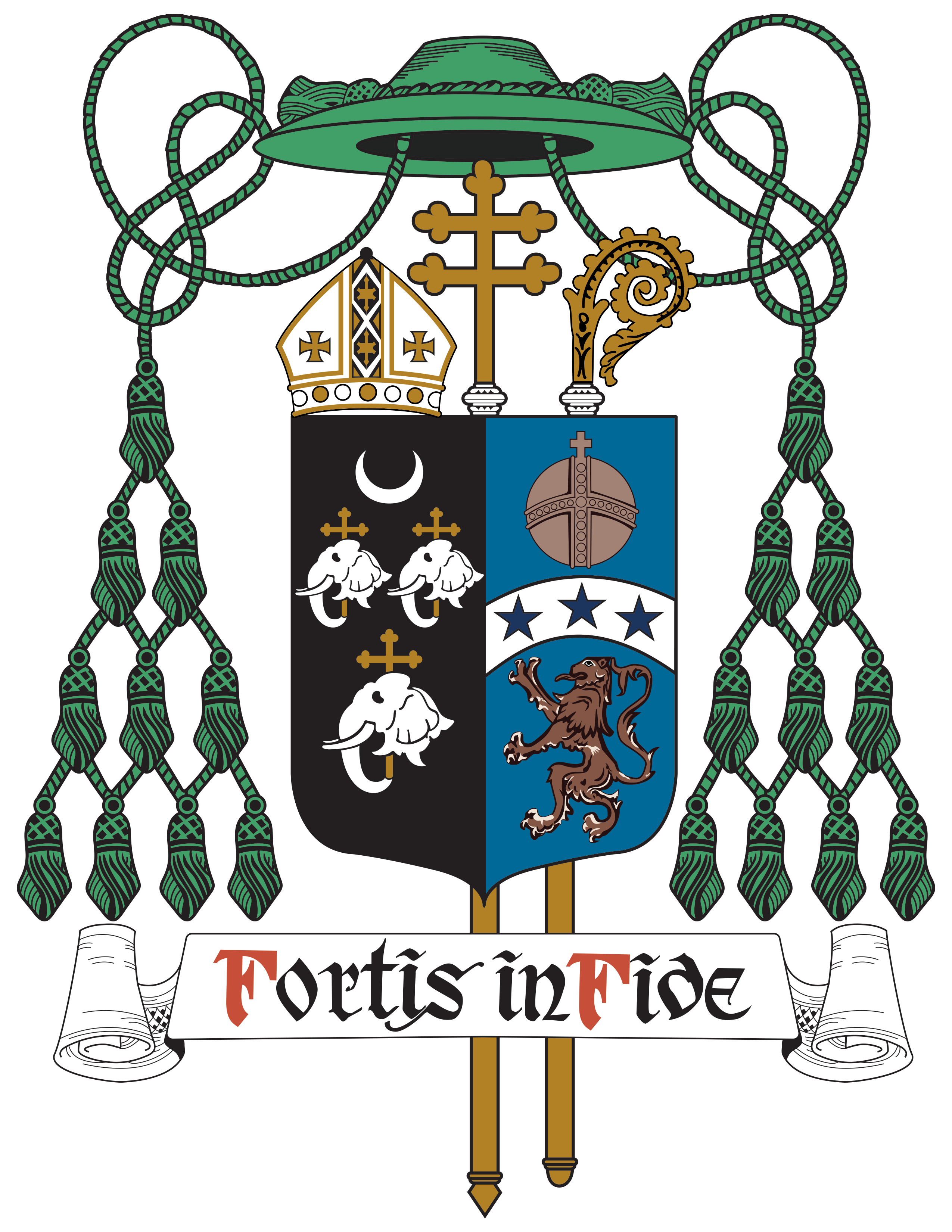
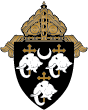
Archbishop Damiano’s coat-of-arms combines his personal insignia on the right with that of the Diocese of Camden on the left. When it is reproduced in color, the emblem emerges in black (sable), silver (argent), blue (azure), and gold (or). In heraldry, by the way, a coat- of-arms is known as an “achievement,” which would seem an apt description.
The Camden, or left side, has a black field with three silver elephant heads derived from the coat of arms of Charles Pratt, the first Earl of Camden, after whom Ja- cob Cooper named the settlement he founded on the bank of the Delaware in 1773.
The dexter portion is completed by a crescent, the emblem of the Mother of God under the title of the Immaculate Conception, representing the Camden cathedral, and three golden crosses in honor of the Blessed Trinity. The crosses are what is known in heraldry as a “difference” because they differentiate the Camden coat from any similar one.
The right side of Archbishop Damiano’s coat-of-arms reflects his personal insignia. The globe and cross at the top represent the Propagation of the Faith, while the three stars in the center and the lion at bottom are family symbols.
Ryan explained that Archbishop Damiano’s coat of arms is finished off, as are those of all archbishops, with a pontifical hat and ten tassels in green, the mitre, the processional cross and crosier. In varying degrees these symbols are common to the coats of all prelates cardinals use 15 tassels, bishops six.
On the coat of a domestic prelate, the hat would re- main but the mitre, cross and crosier would be omitted. The coat of a cardinal has hat and tassels in scarlet and those of bishops and monsignors are purple. A priest uses one black tassel.
When a prelate assumes charge of a diocese or vicariate, his personal arms are emblazoned on the right side of the shield, and those of the diocese or vicariate on the left. A coadjutor or auxiliary bishop displays his personal arms throughout the whole shield.