Bishop Nicholas DiMarzio
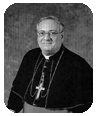
It was announced on June 8, 1999 that Bishop Nicholas DiMarzio, 54, Auxiliary Bishop of Newark, had been appointed sixth bishop of Camden by Pope John Paul II. The canonical possession would be on July 21 at the Cathedral of the Immaculate Conception and the installation at St. Agnes Church on July 22.
Bishop DiMarzio assumed a high-profile role in speaking out for immigrants and refugees. As chairman of the Bishops Committee on Migration, he testified before Congress about the effects of mandatory deportation and mandatory detention provisions of a 1996 immigration law. While he was director of the USCC Migration and Refugee Services Office, he created the Catholic Legal Immigration Network, known as CLINIC, a legal services corporation through which dioceses offer new immigrants help in resettling.
He also turned his attention to the needs of the local church in South Jersey. In response to the rapid growth in Catholic population in Atlantic County, Bishop DiMarzio established St. Katharine Drexel Parish in Egg Harbor Township. A new parish for all Hispanics in Vineland, Immaculate Heart of Mary (Immaculada Corazon de Maria), was founded in December at the former site of the Spanish Catholic Center.
In addition, the Vicariate for Pastoral Planning, with the collaboration of the Vicariate for Pastoral Life, developed a pastoral plan for meeting the needs of the approximately 110,000 Hispanics in the South Jersey area. To meet the needs of Hispanic workers who come to the United States on a temporary basis to work in the agricultural industry, an annual ‘œMass in the Fields is celebrated for the workers.
The Korean communities of the diocese benefited from the establishment of two missions to serve their spiritual needs and established individual missions at Holy Rosary Parish in Cherry Hill, and St. Andrew Kim Korean Catholic Mission in Pleasantville. Vietnamese, Haitian, Filipino and Polish apostolates were also established. Indeed, the high participation in the dioceses Pentecost multi-cultural events is a joyful tribute and celebration of the richness in diversity of the diocese, and a sign of the dioceses openness to welcoming the stranger.
Pastoral Planning and Research
Under Bishop DiMarzio’s leadership, new emphasis was placed on pastoral planning at the parish and diocesan levels, revitalizing structures of colloboration, including parish and diocesan pastoral councils. In his third pastoral letter, Laity in the New Millennium, Bishop DiMarzio noted that these structures of collaboration exist so the laity may ‘œtake their rightful place not only in the world, their primary calling, but also in the Church community where they can bring lay experience to bear on the Church’s mission of evangelization.
Citing the importance of Catholic schools as “value-centered education,” which not only strives for academic excellence, but also excellence in virtue, Bishop DiMarzio established a scholarship fund for low-income families who wish to send their children to Catholic schools. He also oversaw the dedication of new elementary schools, Bishop McHugh Regional Catholic School of Dennis Township, which opened in September 2000, and Guardian Angels Regional School in Gibbstown, which opened in September 2001. Regionalization plans also helped to alleviate situations of declining enrollment at several elementary schools.
Permanent Deacons
The last four years also saw a reorganization and strengthening of the Permanent Diaconate with new emphasis placed on recruitment and training of candidates for future ministry. Currently there are 124 permanent deacons (eight of which are in ministry outside the diocese) and 51 in formation.
Programs to encourage vocations to priesthood and religious life also received major attention. Nazareth House at the former convent at Camden Catholic High School was founded by Bishop DiMarzio as a place for young men to consider a priestly or religious vocation. The residents receive support and spiritual direction, and engage in common prayer.
Bishop’s Pastoral Letter for Social Mission
In March 2001, Bishop DiMarzio published his pastoral letter, ‘œThe Church’s Social Mission in the New Century. In it, he called for a clearer communication of the Church’s social mission as a response to common human dignity elevated by the Incarnation; the development of a culture of life to upgrade respect for human life from conception to natural death and to promote human rights; a restoration of family as the fundamental cell of society and as the ‘œdomestic church; firm adherence to the sanctity of the marriage bond between husband and wife as the foundation for family; sustenance, housing and health care, especially for the needy; job opportunities for the unemployed, for permanent residents and immigrants; welcome of the newcomers and protection of their rights, especially reunification of family; substance abuse, emotional disturbance and mental illness; racism and the oppression of minorities; moral indifference of a large segment of the U.S. population; the suburban/urban divide in our Church with the obstacle and opportunities inherent in that situation.
Enhancement of the dignity of women as a constitutive element of justice and their special role in the Church and society; encouragement and utilization of government support of faith-based initiatives and advocacy of government responsibility in the struggle against poverty.
Human Services
Under Bishop DiMarzio, the Vicariate for Human Services was created and now incorporates Catholic Charities, the Division of Health Services and the Division of Housing Services. A new Human Services Center, housing the offices of the Vicariate, was blessed and dedicated on September 16, 2003 at the renovated site of the former diocesan offices on Haddon Avenue. Meanwhile, renovations at St. Pius X Retreat House and a new Newman Center at Stockton State College were completed under Bishop DiMarzio.
The parishes of the diocese also initiated a major Stewardship program which celebrates the universal call to holiness amongst the people of God in Camden by being generous with one’s time, talent and treasures.
Ecumenical and Inter-religious Affairs
The Bishop’s spiritual concerns, however, reached beyond the diocese’s own parishes and schools to include other faith communities. Joining in the celebration of its 50th anniversary, the Bishop addressed the local Jewish community of Temple Emmanuel in Cherry Hill, calling both faith communities to mutual respect and understanding. The Bishop presided at an ecumenical prayer service with the Lutheran community to celebrate the Joint Declaration on the Doctrine of Justification which was signed by Catholics and Lutherans in Augsburg, Germany.
He also participated in services at Temple Beth El Synagogue in Margate City with the local Jewish community. The establishment of the Catholic-Jewish Commission was a real sign of growth in interreligious affairs. It allows both faiths to speak at once on any issue where religious leaders must speak with one voice. The Catholic-Jewish Institute continues, and participants increase in the courses. Bishop DiMarzio was installed as seventh bishop of Brooklyn on October 3, 2003.

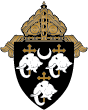
Blazon
Arms impaled. Dexter: Sable, three Latin crosses botonny or, debruised at their base with three ele- phant heads efased Argent, in chief a crescent of the last. Sinister: Azure, above the five plates per arc, a stylized dove descending, the head being replaced with a roundel, voided of the field and charged cross formy Argent, to chief a crescent Or between to dex- ter a fleur-de-lis and to sinister an ermine spot of the second; issuant from base three mountains of the third charged with a trefoil Vert.
Significance
The episcopal heraldic achievement, or as it is more commonly known, the bishop’s coat of arms, is composed of a shield, with its charges, a motto scroll and the external ornaments. The shield, which is the central and most important feature of any heraldic device, is described (blazoned) in twelfth century terms as if it were being worn on the arm and is being viewed from the rear. Thus, it must be understood that the terms dexter and sinister are reversed as the design is viewed from the front.
By heraldic tradition, the arms of a bishop of a diocese are joined (impaled) with the arms of his jurisdiction, seen in the dexter impalement (left side) of the shield, in this case the Diocese of Camden. The three elephant heads signifying power, fidelity and wisdom, are from the coat of arms of Charles Pratt, first Earl of Camden and Lord Chancellor of England, for whom the city of Camden was named, In 1773, Jacob Cooper, a descendant of William Cooper, who in 1681 had built a home just below the mouth of the Cooper River, laid out a town and named it in commemoration of Lord Camden, the friend and defender of the rights of the American colonies. The sense of justice prevailed so strongly in the Chancellor that the English government asked
An Explanation
him to resign his high post, after one of his judicial decisions denounced the Stamp Act as a breach of the English Constitution, and declared taxation of the colonies without representation to be sheer rob- bery.
The three golden crosses honor the Blessed Trinity: Father, Son and Holy Spirit. These crosses are what is known in heraldry as the “difference” because they differentiate the Camden diocesan coat of arms from that of the Earl of Camden. With this “difference” the significance of the qualities of power, fidelity and wisdom is transferred to the spir- itual order.
The crescent at the top center of the shield repre- sents the Immaculate Conception, the title of the Cathedral of Camden and the title under which the Blessed Virgin Mary is venerated as patroness of the Diocese of Camden.
For his personal arms, seen in all the sinister impalement (right side) of the shield, adopted at the time of His Excellency’s election to Auxiliary Bishop of Newark, New Jersey, Bishop DiMarzio has employed a design that brings together those ele- ments of his priestly service that have had the most significance in his life.
The symbolic waters are taken from the coat of arms of the Archdiocese of Newark, which comes from the City of Newark, England from which the early settlers of Newark, New Jersey originated. Floating on the waters is an ark, symbolizing Noah’s means of escape from the great flood. Catholic Community Services, where Bishop DiMarzio has served for over 15 years, has been described as the new ark in the City of Newark which offers hope and solace for those coming for assistance. As the new ark in Newark, it has become a means of salva- tion by overcoming the destructive forces around it. The white dove pictures the dove sent by Noah to
find dry land. The dove returns to the arc with the olive branch in its beak, a symbol of peace and rec- onciliation between God and man.
The upper part of the coat of arms symbolizes the Mount of Carmel, its two prophets and the Queenship of the Blessed Virgin Mary. Bishop DiMarzio served as Executive Director of Catholic Community Services, the amalgamation of the Mount Carmel Guild and Catholic Charities. Also, Bishop DiMarzio has been a resident of Mount Carmel Parish in Newark, New Jersey for many years. In addition, he has a very special devotion to Our Lady of Mount Carmel. The two stars of either side of the symbolic mountain symbolize Elijah, the great prophet of Carmel, and Elisha, his disciple who follows in his footsteps. Bishop DiMarzio’s paternal grandfather was born in the town of S. Elia a Painisi in the Molise Region of Italy. The town bearing the prophet’s name also has a church dedi- cated to Our Lady of Mount Carmel. The white star symbolizes the Blessed Virgin Mary. Bishop DiMarzio’s motto, Ecce Matrem “Behold Thy Mother,” are the words of Jesus from the cross found in St. John’s Gospel, through which Jesus leaves us Mary as our very own mother. Mary is a symbol of the mystery of the Church. The Church is our com- mon Mother, to whom all of us owe our generation in the faith. In these times of turbulence, we must look toward our common mother, Mary, and the Church to guide us through to find the peace Jesus meant for us.
The cross in the coat of arms is the San Damiano cross before which traditionally St. Francis of Assisi received the stigmata. Bishop DiMarzio’s confirma- tion name is Francis, showing his special devotion to St. Francis of Assisi and whose Prayer of Peace he prays daily.