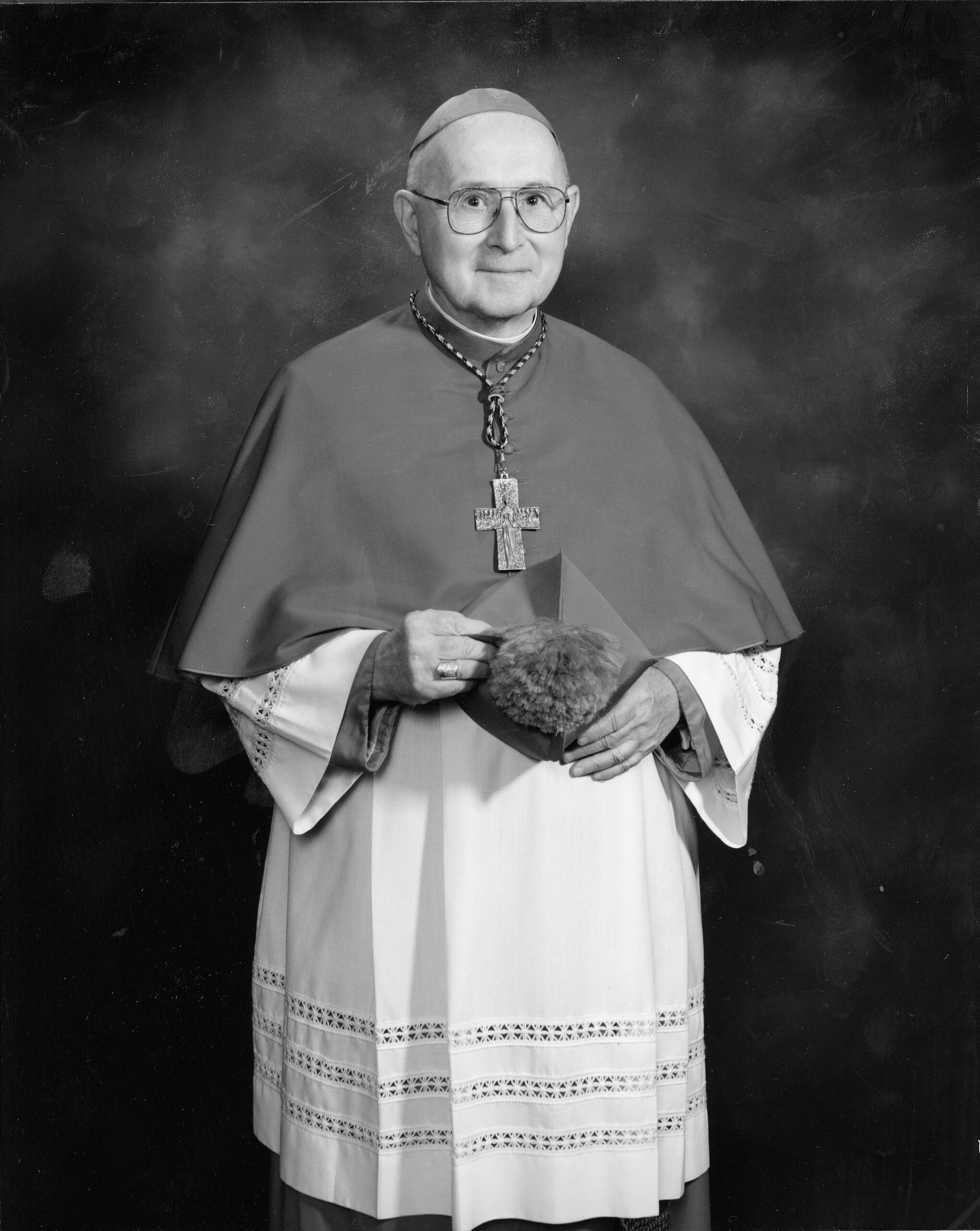
Auxiliary Bishop James L. Schad (1966-93)
The first and only Auxiliary Bishop in the Diocese of Camden, James L. Schad was the first pastor of the new Most Holy Redeemer Parish in Westville Grove in 1958. Eight years later, he became bishop. He remained in Westville Grove for one more year and also become vicar general, and director of Catholic Charities and the House of Charity.
From the 1970s until 1990 he was moderator of the diocesan Charismatic Renewal Movement, and during this time also served as pastor of Saint Rose of Lima, Haddon Heights (1967-79); Maris Stella, Avalon (1979-85); and the Cathedral of the Immaculate Conception, Camden (1985-2002).
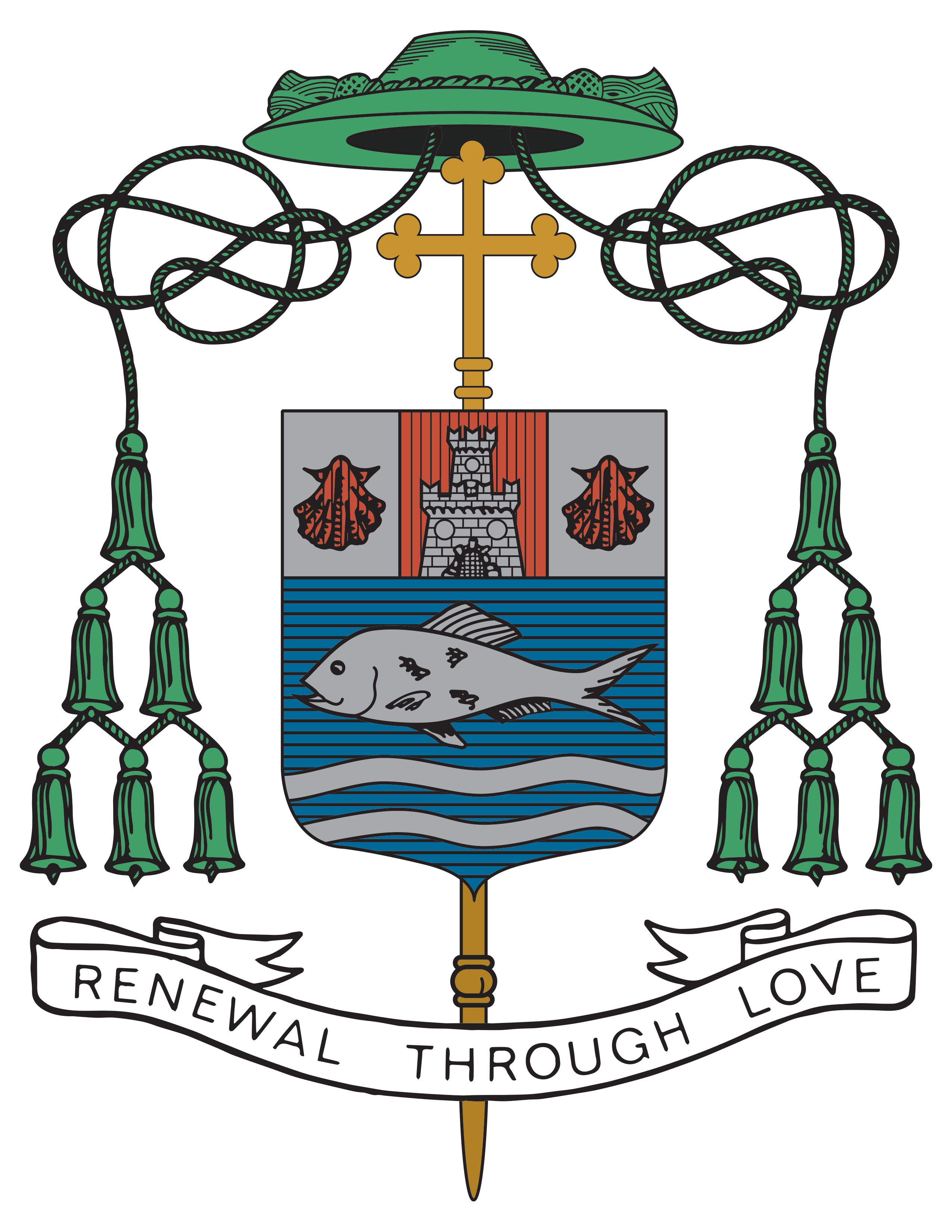
Bishop Schad’s Coat of Arms
The fish is appropriately the CAMDEN outstanding symbol of the coat-of-arms de- signed for Bishop-elect James L. Schad by W.F.J. Ryan of New York.
The Bishop’s surname has several mean- ings in German denoting injury, harm, loss, damage and the shad fish, but the latter was chosen because of its Christian and biblical significance.
The Encyclopedia of Muret-Sanders points out that the German word “schad” is the ex- pression used by zoologists for the shad fish. It is a fitting symbol for a successor to the Apostles since there are many references in the New Testament in which Christ refers to the Apostles as fishermen.
In addition, the fish was used by the an-cient Christians in the catacombs in order to avoid the suspicions of the pagans who also used the symbol of the fish in their own rites. The Greek word for fish, “Ichthus,” also happens to be an acrostic meaning “Jesus Christ, God’s Son, Saviour.”
Rietstop’s Armorial General from Bavaria and Wurtemberg lists three Schad coats-of- arms, but their association with the Bishop’s branch of the family is vague, according to the armorist.
The fish displayed on the coat-of-arms is a facsimile of the shad. It is tinctured in its natural silver color and placed on a blue field above wavy bars of silver. The combination of blue and wavy sliver bars are symbolic of water, sea or a river in heraldry.
The upper part of the escutcheon contains the symbols of the Bishop’s patron saint, St. James the Greater, and of the Gandolfo. family of his mother.
The escallop shells that decorate both up- per corners have been recognized for centuries as the marks of St. James, the first of the apostles to be martyred. A ninth century legend makes him the apostole of Spain and the city of Compostella his shrine where thousands of pilgrims annually continue to follow the Route of St. James from South- ern France through Navarra to the holy shrine in Gallicia. Years ago those who made the pilgrimage were entitled to wear the escallop shell on their garments to commemorate the appearance of St. James on a white horse with its caparisons decorated with escallops at the battle of Olavijo, where he brought victory to the Christians fighting the Moors. The castle is derived from the coat of arms of the Gandolfo family and is now evident in Castel Gandolfo – the summer house for the Roman pontiff. The complete Gandolfo arms consists of a lion to the right of the low- er part of the tower and a soldier carrying a banner and standing on the top. The field is the same blue as that of the episcopal arms. The Bishop’s motto, “Renewal Through Love,” is derived in part from the Bible pass- age in I Kings, 11:14: “And Samuel said to the people: Come and let us go to Galgal, and let us renew the kingdom there.”