“Encountering Mercy” is a series that explores the corporal works of mercy during the Jubilee Year through the people whose lives exemplify them. The first is “Welcome the Stranger” and features profiles of refugees living in the Diocese of Camden, bringing to light their stories of suffering and resilience and their contributions to their new communities.
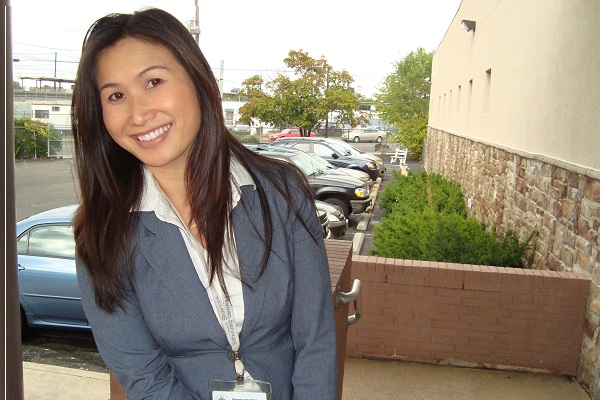
Thuy Le was 9 when she left Vietnam with her parents and three siblings. She had no idea just how difficult life had become for her parents.
Her father had served as an interpreter for the American military during the Vietnam War. After the war, his involvement made him the target of intense scrutiny by the Vietnamese government. He was taken to a forced labor camp for two months until the family raised enough money to bail him out. After that, he was required to check in each day with government authorities.
“He was being monitored every day and that was very uncomfortable to him. I didn’t know any of this, I was just a kid, but they were in fear that the government could come over anytime they wanted and harm him and the family,” Thuy said.
They lived with the constant threat of Thuy’s father being sent back to the brutal labor camp. In 1990, her parents decided to make good on the U.S. government’s offer of refugee status for Vietnamese who had been part of the American military during the war.
They went first to a temporary camp for refugees in the Philippines run by the U.S. government. Her parents were given work at the camp, the children went to school to learn English, and the family received vaccinations and medical examinations. Normally the process took six months, but the Le family stayed a year because of health concerns.
Although the transition was challenging, Thuy remembers the Philippines as a “happy time.”
“We were established in Vietnam and just to pick all that up and go, that was tough for me, especially to leave my friends and school,” she said. “But in the Philippines we had all the freedom we needed, no one was being watched; it was a relief for my parents. It was a good process because we had the opportunity to get assimilated to what to expect in this country.”
In December of 1991 they arrived to below zero temperatures in Chicago, and an aunt helped them get on their feet in their new country.
After two years, the family moved to New Jersey for jobs and warmer weather. Thuy’s parents found work at a Quickie Manufacturing plant making cleaning products. By now the family had grown to eight, with one child born in the Philippines and another in the U.S.
“It was just the eight of us; we depended on each other for everything,” Thuy said. “Even today, every big decision anyone makes in my family, we still sit down together and discuss it. It’s a habit.”
When she was 13, Thuy joined her older siblings working at Quickie Manufacturing after school. In the summers, she and her siblings continued to work at the manufacturing plant and added jobs picking blueberries in the fields. Half of the money they earned they could keep and the rest was put in the communal family fund and used to help pay the mortgage or put the kids through college.
At 16, Thuy passed the exam to become a certified interpreter and started working in courts and hospitals. She also took on a job as a secretary in a doctor’s office. Her interpretation work caught the eye of the director of Catholic Charities’ School-Based Family Counseling Program and she was hired as a part-time consultant, attending teacher conferences and other events to provide interpretation services for Vietnamese families.
She continued working as she attended Rowan University. Her senior year she was hired full-time by Catholic Charities to work in the Refugee Resettlement Program. She finished school a full-time student and a full-time case worker.
All six of the Le children graduated college.
“We didn’t have a choice,” Le says, laughing. “Our parents were very strict. My mom and my dad said this: in this country all you have to do is work really hard and go to school. They wanted us to be successful and contribute and give back and that’s what all of us did.”
Today, all six have successful careers. None of them have been able to shake the habit of giving back a little each month to their parents, even though the need is no longer as great. They’re helping them save for retirement.
Thuy is now a case manager at Catholic Charities and a successful entrepreneur. Her husband manages a small business the couple started together after college. She has her pilot’s license and owns a recreational plane. She spends every spare moment with her husband and 6-year-old daughter having adventures: flying, four-wheeling, hiking, boating.
But it is her work at Catholic Charities that supplies a deeper need. She’s worked for the agency ever since that first job in high school, switching over in 2005 to the Welfare to Work Program. She assists people in moving toward self-sufficiency as their public assistance benefits are set to expire.
“Coming from a refugee background, my family always said it’s wrong not to give back,” she said. “My work at Catholic Charities allows me to do that. I need that spiritual support.”
Conditions have significantly improved in Vietnam today. Thuy and her parents have been back for visits several times. Her parents are considering buying a home and retiring there.
But Thuy says her father still isn’t completely comfortable moving back to his homeland because of his traumatic experiences under government surveillance and in the forced labor camp.
At the wishes of their parents, all six of their children have remained in South Jersey, most of them living in the same town in order to be near each other. The entire family comes together for dinner two or three nights a week.
“Spouses and children make 22 of us now,” Thuy says. “My mom cooks and she has us all come home so she can see what’s going on with our lives.”
Her advice for refugees who have recently arrived is simple: “Follow the rules, work really hard, go to school. If my family can make it to where we are, because that’s what we did, you can do it too.”
Written by Joanna Gardner
*****************************************************
The mercy of embracing refugees
In 1952, Pope Pius XII’s apostolic constitution Exsul Familia Nazarethana definitively established the church’s responsibilities toward migrants and refugees. Published in the wake of the Second World War, the constitution holds up the Holy Family as the model for all migrant families, a theme introduced in its opening paragraphs:
“The émigré Holy Family of Nazareth, fleeing into Egypt, is the archetype of every refugee family. Jesus, Mary and Joseph, living in exile in Egypt to escape the fury of an evil king, are, for all times and all places, the models and protectors of every migrant, alien and refugee of whatever kind who, whether compelled by fear of persecution or by want, is forced to leave his native land, his beloved parents and relatives, his close friends, and to seek a foreign soil.
“For the almighty and most merciful God decreed that His only Son, “being made like unto men and appearing in the form of a man,” should, together with His Immaculate Virgin Mother and His holy guardian Joseph, be in this type too of hardship and grief, the firstborn among many brethren, and precede them in it.”
[imic_button colour=”btn-default” type=”enabled” link=”http://catholicstarherald.org/living-the-american-dream-a-vietnamese-refugees-story/” target=”_self” extraclass=”” size=”btn-lg”]Read in Catholic Star Herald[/imic_button]