The Mass of Chrism is celebrated in the Church of Saint Agnes in Blackwood annually, at 3 PM on the Tuesday of Holy Week. Although by tradition, the Chrism Mass is a Holy Thursday morning celebration, to allow for the participation of more of the clergy and the laity, the Church permits it to be celebrated on another day before Holy Thursday. The Mass is a great gathering of the whole diocesan family, with people coming together from so many of our parishes. It is a wonderful feast of ceremonial and fine liturgical music.
During this Mass, Bishop Sullivan blesses the Oil of Catechumens the Oil of the Sick, and consecrates the Sacred Chrism. These oils are integral to the sacramental life of our communities during the year.
The church uses the Oil of Catechumens for adult catechumens in preparation for baptism, and for infants during the Rite of Baptism.
The Oil of the Sick is for anointing those who seek healing andwholeness through the grace of the Sacrament of the Anointing of the Sick.
The sacred oil of Chrism is reserved for post-baptismal anointing of infants, Confirmation, the Ordination of Priests, and the Dedication of Altars.
The three oils are basically olive oil, yet to the Sacred Chrism is added a special fragrance which fills the air with the scent of sweet perfume. One early church writer described the perfume of Chrism as “the Easter aroma, God’s grace incarnate through the sense of smell!”
Bishops have blessed oil from the days of the early church. They personally baptized catechumens at the Great Easter Vigil and prepared Sacred Chrism fresh for the occasion. Later on, rather than overburdening the Easter Vigil with the blessing of oils, bishops blessed these oils at the previous celebration of Mass on Holy Thursday. After this celebration vessels of oil were then taken to all churches in the diocese. In Rome the one Mass of Holy Thursday served for the commemoration of the Lord’s Supper and the blessing of oils.
By the 13th century, the priests gathered for the liturgy were invited to join in the prayers of blessing with the bishop. With relatively minor adjustments, the liturgy remained the same through to the 20th century. In 1955 the rites of Holy Week were revised for the universal Church. The celebration of Holy Thursday became marked by two separate Masses, one in the morning for Chrism, the other in the evening for the Lord’s Supper.
Only the Bishop may consecrate the Sacred Chrism, therefore in a very special way the Chrism Mass highlights his ministry and our union with him as a Successor to the Apostles. The Bishop is not personally able to baptize and confirm everyone in the parishes of the diocese, but his ministry is symbolically present in the chrism which the priests and deacons will use.
Also in recent years, this Mass has also acknowledged the ministry of priests. It invites them to renew their commitment of service and to receive the prayers and support of the people.
The Mass of Chrism gathers the faithful of the diocese with their shepherd to prepare for celebrations of Christ in all our churches throughout the year.
The holy oils are then solemnly received into our Parishes during the Mass of the Lord’s Supper or at another suitable time. The oils are placed in noble and dignified containers and stored in a suitable place, often visible to the community. Through the liturgy of the Church, Christ acts to strengthen and protect, to heal and restore, to set apart and seal for ministry. The Chrism Mass serves to signify these realities to the community of faith.
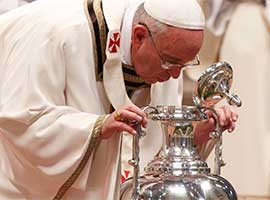 Photo courtesy of USCCB website: http://www.usccb.org/prayer-and-worship/liturgical-year/lent/roman-missal-and-the-chrism-mass.cfm