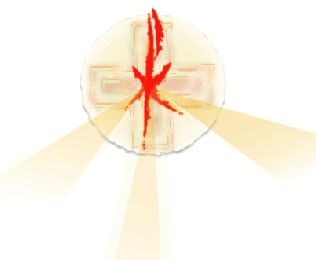
 The Chi Rho is the prime symbol of Christ, who is the head of His Church. It consists of X and P, representing the capitalized Greek letters chi and rho, which are equivalent to CH and R in Latin or English, the first three letters of the word Christ. It is rendered in red overlayed on the image of the cross, calling to mind Jesus’ redemptive sacrifice. Lumen Gentium, the Dogmatic Constitution on the Church, notes that the origin and growth of the Church are symbolized by the blood and water which flowed from the open side of Jesus on the cross.
The color red also conveys a Pentecostal dimension, suggesting the inspiration of the Holy Spirit which enlivens the people of God for mission.
Rays of light represent the light of Christ. Lumen Gentium—which is a foundational document for the diocesan Vision—derives its name from the first words of the document: Christ, the Light of Humanity. The rays also suggest also the light emanating outwards from His Church:
Lumen Gentium notes:
” the Church exists to bring to all people the light of Christ which shines out visibly from the Church.” (LG 1).
The rays, three in number, conveys the Trinity, the central mystery of the Catholic faith. The Catechism notes that the Trinity:
“is the source of all the other mysteries of faith, the light that enlightens them” (CCC, 234).
The image calls to mind that Christians are baptized “in the name of the Father, the Son and the Holy Spirit.” It reminds us that we are called into the unity of the Trinity “here on earth in the obscurity of faith, and after death in eternal life.” (CCC 265). The perfect, divine unity of the Trinity is the basis for the unity we strive for as Church. Just as the Persons of the Trinity are “inseparable in what they are and inseparable in what they do,” clergy, religious and laity are united by virtue of their baptismal identity and strive for unity as they carry out the mission of the Church. Finally, the three rays remind us of the three-fold offices of Christ that each of the baptized shares in: the priestly, prophetic and kingly.
The circle suggests three things:
- In contrast to a vertical model of the Church (with Pope, Bishops, Priests, Religious and laity ranked in descending order), the circle reminds us of the equality of the people of God conferred through baptism.
- The circle also suggests unity, the unity which the People of God strive for even in their diversity. Likewise, it stresses the universality or “catholicity” of the Church;
- Finally, the circle is a Eucharistic symbol. The Eucharist is the source and summit of Christian life (it makes present Jesus’ salvific suffering, death and resurrection), brings about unity, and sustains the people of God so that the Church can carry out its mission in today’s time and place. As Lumen Gentium notes,
“[I]n the sacrament of the eucharistic bread, the unity of believers, who form one body in Christ is both expressed and brought about.” (LG 3). - And again,
“[Strengthened by the body of Christ in the eucharistic communion, they manifest in a concrete way that unity of the People of God which this holy sacrifice aptly signifies and admirably realizes.” (LG 11).